🚨 If this is happening now: Move your dog into shade or air conditioning. Pour cool water over them, focusing on the belly, armpits, groin and paws, and get air moving over the wet coat. Start cooling before you drive. Then call VetCare Veterinary Medical Centre on 050 550 16 98 (after hours) or (971) 4 430 9797 and come in.
Everything else on this page can wait. Cooling cannot.
Why this article exists
With heatstroke, what the owner does in the first ten minutes changes the outcome more than what the vet does in the first hour.
That isn’t an exaggeration. In research on canine heat-related illness, among dogs cooled by their owner before transport, only 10.8% required further cooling at the veterinary practice on arrival. That evidence is why the veterinary profession now pushes a simple message: cool first, transport second, and that it needs to be front and centre in first-aid advice for dogs with heat-related illness.
In Dubai this matters more than almost anywhere. Summer here runs from roughly late April to early October, with July and August average highs above 43°C and overnight lows barely dropping below 30°C. A dog that overheats at 2 pm in Al Barsha doesn’t get a cool evening to recover into.
What heatstroke actually is
A dog’s normal body temperature sits at roughly 38.3 to 39.2°C (101 to 102.5°F).
Clinically, heatstroke is defined as a non-pyrogenic rise in body temperature above 40°C (104°F), along with a range of systemic signs. The distinction from a fever matters. A fever is the body deliberately raising its set point to fight infection. Heatstroke is the body’s cooling system being overwhelmed and losing control of itself.
Above about 41.1°C (106°F), organ damage begins, and if body temperature reaches roughly 41.2 to 42.7°C, multiple organ failure can follow, and the condition can be fatal.
What’s actually happening inside the body: the elevated temperature triggers a release of inflammatory compounds, alters how cells function, denatures proteins and enzymes, and causes cell death, damaging the lungs, heart, kidneys, brain and blood clotting pathways along the way.
This is a systemic, multi-organ emergency with a very short clock, not a dog that’s simply overheated and needs a rest.
Heat Exhaustion vs. Heatstroke, The Comparison Table
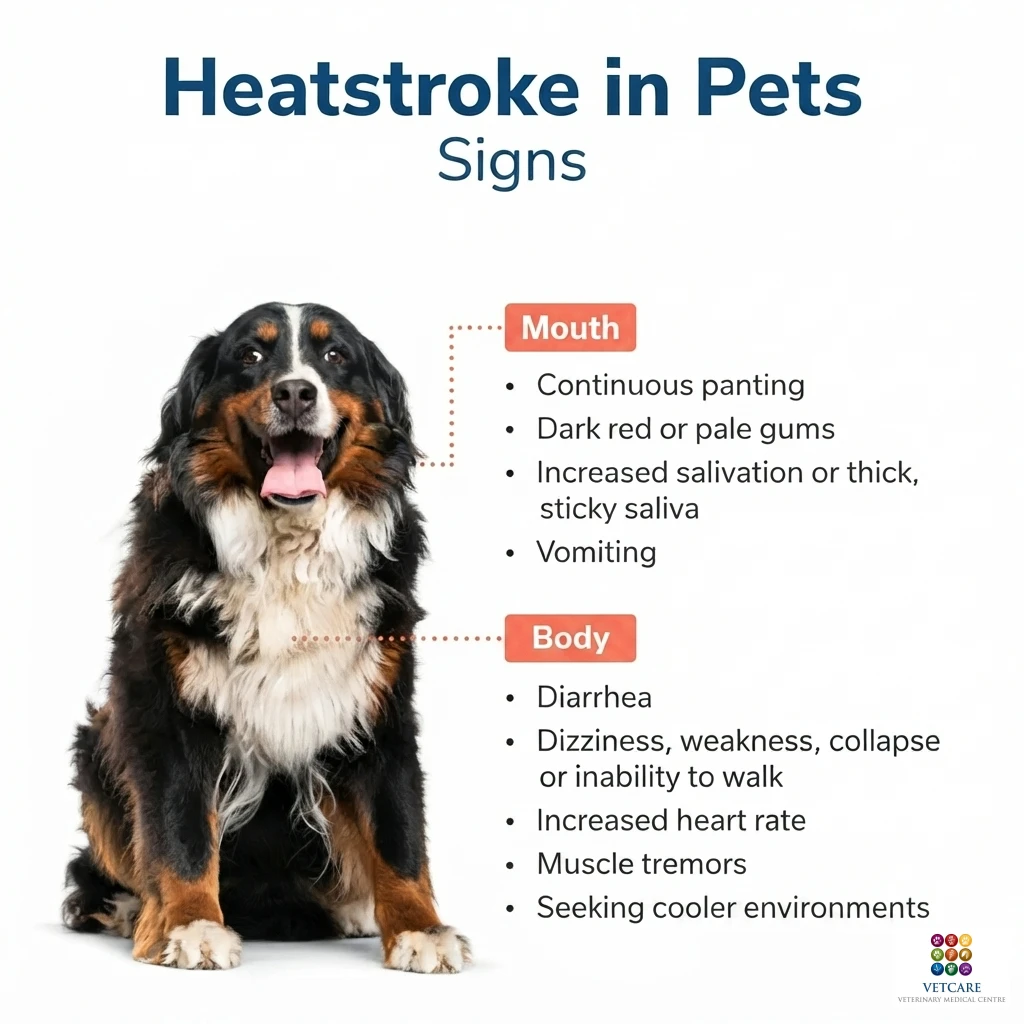
| Heat Exhaustion (early, reversible) | Heatstroke (emergency) | |
| Panting | Heavy but rhythmic | Frantic, desperate, noisy, or (ominously) panting that stops |
| Gums | Normal pink, perhaps tacky | Bright red / brick red, or pale, grey or blue |
| Drooling | Increased | Thick, ropey, excessive |
| Behaviour | Slowing down, seeking shade, lying flat | Disoriented, glassy-eyed, unresponsive, stumbling |
| Coordination | Normal | Wobbly, staggering, collapse |
| Gut signs | Usually none | Vomiting, diarrhoea, sometimes with blood |
| Consciousness | Alert | Dull, confused, seizures, unconscious |
| Rectal temp | Elevated, generally below 40°C | Above 40°C (104°F) |
| What to do | Stop activity. Move to cool. Offer water. Monitor closely. | Cool immediately. Then go to the vet. Now. |
The line you must not miss: any change in mental state (confusion, unsteadiness, glazed eyes, unresponsiveness) moves the dog from the left column to the right column. A change in mentation is the alarm.
And the counterintuitive one: a dog that suddenly stops panting is not calming down. It may be decompensating. Treat it as an emergency.
The VetCare 10 Minute Heatstroke Action Plan
MINUTE 0 TO 1: STOP AND MOVE
Stop all activity. Get the dog out of the sun and off the hot ground, into shade, into a car with the air conditioning already running, into a building. Carry them if you can. Don’t make them walk.
MINUTE 1 TO 3: COOL, AND COOL AGGRESSIVELY
Get water on the dog. Whatever water you have.
Soak the whole body, prioritising the belly, armpits, groin and paws, since these areas have less fur and more surface blood flow.
Use cool water and don’t overthink the temperature. There’s a persistent myth worth killing here: the advice to “only use tepid or lukewarm water” isn’t supported by the evidence. Use whatever water is available, as long as it’s cooler than the dog. One study simulating a hot desert climate found that dogs can cool even in 30°C water.
Don’t delay cooling while you hunt for the “right” water. In a Dubai summer, tap water sitting in an exposed pipe may itself be warm. Use it anyway if it’s cooler than the dog, and look for better water at the same time.
The one genuine caution: don’t pack a dog in ice or immerse a collapsed dog in ice water without veterinary guidance. Aggressive cooling is correct. Extreme cooling is not.
Water alone is slow. Water plus airflow is fast. Point a fan at the wet dog, open the car windows, run the air conditioning on full. Evaporative cooling is what actually pulls heat out.
MINUTE 5 TO 7: MEASURE, IF YOU CAN
If you have a rectal thermometer, use it. If you don’t, don’t waste time hunting for one. Keep cooling.
The target is to get the temperature moving downward, aiming to bring it below 40°C before the dog goes into the vehicle.
MINUTE 7 TO 8: WATER TO DRINK (ONLY IF FULLY CONSCIOUS)
If the dog is alert and willing, allow small sips of cool water. Never force water into a dog that’s drowsy, disoriented, collapsed or vomiting. It will go into the lungs.
Call ahead so we can prepare for your arrival. Keep cooling in the car, windows down or AC on full, air moving over the wet coat, all the way here.
This step is genuinely dangerous to get wrong. You can overshoot.
Monitor the temperature every 5 minutes, and once it reaches roughly 39.7 to 40°C (103.5 to 104°F), stop active cooling to avoid rebound hypothermia.
Cooling below the target is its own emergency. Stop at the line.
“Cool First, Transport Second”
Your dog is showing heatstroke signs. Your instinct is to grab the keys and drive.
Is the dog conscious, and can you access water right now?
Yes: cool for 3 to 5 minutes before you get in the car. Soak the body. Get airflow on it. Then drive, continuing to cool en route. Cooling before the vet visit has been linked to a real improvement in survival, so don’t skip it just to arrive faster.
No, no water available, or the dog is collapsed or seizing: drive now. Get the AC on maximum and directed at the dog. Call ahead. Don’t spend minutes searching for water you don’t have.
Are you more than 20 minutes from a clinic? Cool for longer before you leave. The longer the dog stays hot, the more permanent the damage. Tissues like the brain and kidney may never recover.
The dog seems to have recovered and is acting normal. Can I skip the vet?
No. Come in anyway.
This is the trap. Heatstroke damage isn’t always visible on the surface. Many dogs are hospitalised for monitoring because problems can develop after the temperature is back to normal. Clotting disorders, kidney injury and gut damage can show up hours later. A dog that “bounced back” can deteriorate that night.
A dog that has had a heatstroke episode needs to be examined, full stop.
The Dubai Heatstroke Risk Matrix
(Score your own dog. Highly engaging, highly shareable, drives wellness check bookings.)
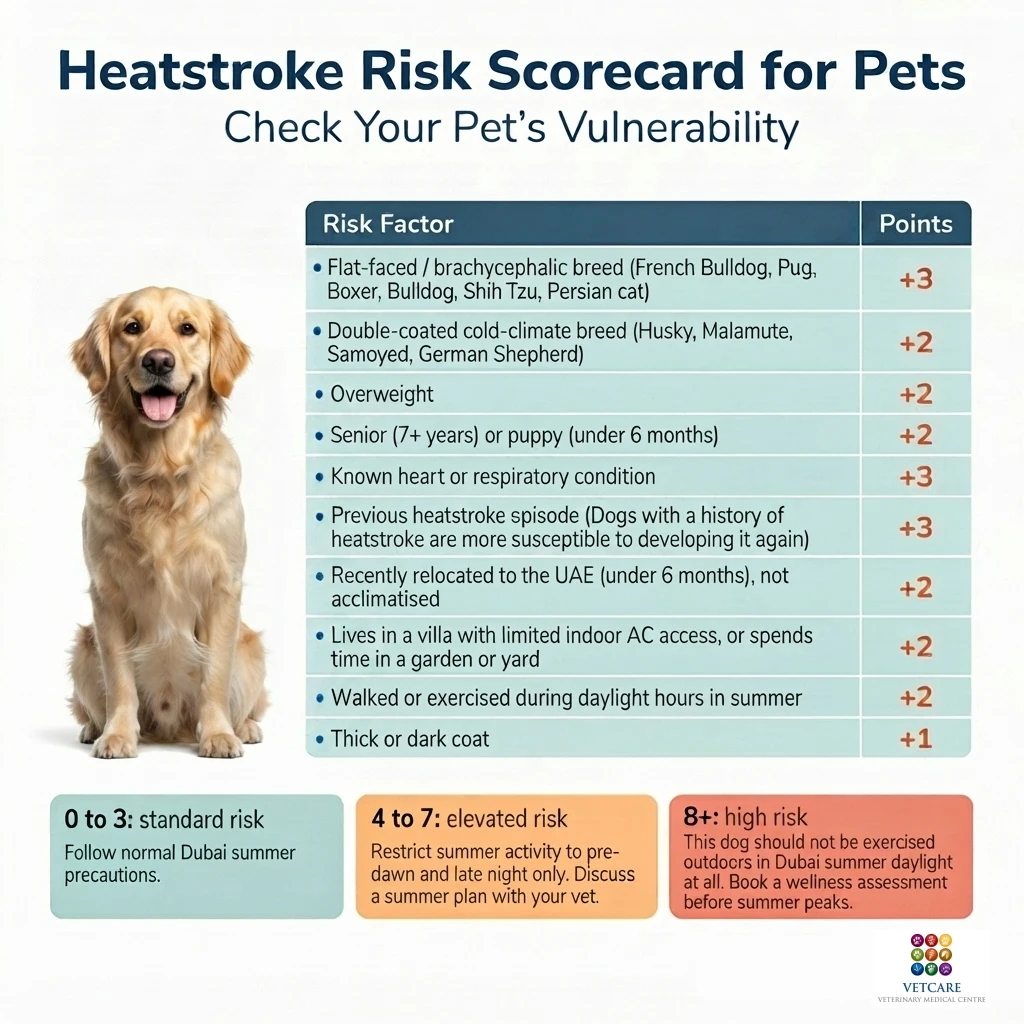
Add up your dog’s points:
| Risk factor | Points |
| Flat-faced / brachycephalic breed (French Bulldog, Pug, Boxer, Bulldog, Shih Tzu, Persian cat) | +3 |
| Double-coated cold-climate breed (Husky, Malamute, Samoyed, German Shepherd) | +2 |
| Overweight | +2 |
| Senior (7+ years) or puppy (under 6 months) | +2 |
| Known heart or respiratory condition | +3 |
| Previous heatstroke episode. Dogs with a history of heatstroke are more susceptible to developing it again | +3 |
| Recently relocated to the UAE (under 6 months), not acclimatised | +2 |
| Lives in a villa with limited indoor AC access, or spends time in a garden or yard | +2 |
| Walked or exercised during daylight hours in summer | +2 |
| Thick or dark coat | +1 |
0 to 3: standard risk. Follow normal Dubai summer precautions. 4 to 7: elevated risk. Restrict summer activity to pre-dawn and late night only. Discuss a summer plan with your vet. 8+: high risk. This dog should not be exercised outdoors in Dubai summer daylight at all. Book a wellness assessment before summer peaks.
The Dubai-specific triggers we see most often
1. The parked car. Non-negotiable, and worth restating with UAE numbers. Research from Stanford University Medical Centre found that a vehicle’s interior temperature can rise by an average of around 22°C (40°F) within one hour, regardless of the outside temperature. Start from a Dubai baseline of 43°C and the arithmetic turns lethal within minutes. Cracked windows don’t solve it. Never leave a dog in a parked car, for any length of time, for any reason.
2. The “quick” midday toilet break. Ninety seconds on a scorching podium terrace or villa driveway. Owners genuinely don’t perceive this as exercise, but the dog is on a superheated surface, breathing superheated air.
3. The balcony or garden without shade. Dubai villa gardens can be sun traps with no shade at any hour. If your dog has outdoor access, walk the space at 2 pm in July and check whether there’s genuine shade and water.
4. AC failure. It happens. A compressor fails, a building has an outage. In a Dubai summer, an apartment without AC becomes dangerous for a dog within hours. Have a plan.
5. The newly arrived expat dog. A dog that flew in from London in June has no acclimatisation whatsoever. Its first Dubai summer is its most dangerous.
6. The dog left with a well-meaning but uninformed sitter or dog walker. Print the 10 Minute Action Plan and give it to them.
Common mistakes that make heatstroke worse
- Driving first, cooling second. The most common and most costly error.
- Waiting for “the right water.” Cooler than the dog is good enough. Start now.
- Wrapping the dog in wet towels and leaving them on. A soaked towel left in place traps heat. Water-soaked towels are the most common owner cooling method, but they’re not what veterinary consensus recommends. Cold water immersion and evaporative cooling are. If you do use towels, keep re-wetting and re-applying them, and keep air moving.
- Forcing water into an unconscious or drowsy dog. There’s an aspiration risk.
- Cooling too far. Stop at around 39.7 to 40°C.
- Going home because the dog perked up. Come in anyway.
- Assuming it can’t be heatstroke because the dog was in the shade. High humidity impairs evaporative cooling, and Dubai’s coastal humidity is a genuine compounding factor.
What we will do at the VetCare Veterinary Medical Centre
Knowing this helps explain why the visit isn’t optional.
- Rectal temperature and controlled continuation of cooling
- IV fluids to support blood pressure, circulation and kidney perfusion
- Oxygen support where needed
- Bloodwork to assess kidney function, liver enzymes and clotting
- Monitoring for delayed complications, including disseminated intravascular coagulation (DIC), acute kidney injury and brain swelling
- Hospitalisation where indicated, because deterioration can occur after the temperature normalises
Prognosis depends heavily on how high the temperature went, how long it stayed there, and how quickly treatment began. That last variable is the one you control.
Frequently Asked Questions
What are the first signs of heatstroke in a dog?
Frantic or noisy panting, thick drooling, bright red gums, and, critically, any change in mental state such as disorientation, stumbling or glassy eyes. Vomiting, collapse or seizures indicate advanced heatstroke.
What temperature is heatstroke in dogs?
Clinically, a non-fever body temperature above 40°C (104°F) with systemic signs. Above roughly 41.1°C (106°F), organ damage begins.
Should I use cold water or lukewarm water to cool my dog?
Use cool water and don’t delay while chasing a specific temperature. The advice to use only tepid or lukewarm water isn’t supported by the evidence. Use whatever water is available, as long as it’s cooler than the dog. Avoid packing a collapsed dog in ice.
Should I cool my dog first or drive to the vet first?
Cool first, then transport, continuing to cool in the car. Starting first aid at home is linked to a real improvement in survival. The exception: if you have no water at all, or the dog is collapsing or seizing, drive immediately with the AC on maximum.
My dog seems fine now. Do I still need to see a vet?
Yes. Complications can develop after the temperature returns to normal, which is why many dogs are hospitalised for monitoring. Come in.
How quickly can heatstroke kill a dog?
It can become life-threatening within minutes. The interval between panting heavily and collapsing can be very short, particularly in flat-faced breeds and in Dubai’s summer heat and humidity.
Can cats get heatstroke in Dubai?
Yes. It’s less commonly recognised, but flat-faced cats (Persians, Exotic Shorthairs), senior cats and any cat trapped in an unventilated space are at real risk. The same emergency principles apply.
Is my dog at risk indoors in Dubai?
If the air conditioning is working, generally no. If AC fails, or the dog has access to an enclosed balcony, a sun-trapped room, or a garden without shade, yes.
VetCare Veterinary Medical Centre Emergency Care
VetCare Veterinary Medical Centre has provided emergency and critical care in Dubai since 2009, with specific expertise in the heat-related conditions common to this region.
We offer 24/7 emergency care.
📞 Clinic (8:30 am to 7:00 pm): (971) 4 430 9797
🚨 After-hours emergency (7:00 pm to 8:30 am): 050 550 16 98
📍 1 Arjan, Diamond Business Centre, Al Barsha South, Dubai. Free parking behind the clinic.
Medical disclaimer
This article provides general first aid guidance and does not replace individual veterinary assessment. Suspected heatstroke is a medical emergency: begin cooling immediately and contact a licensed veterinarian without delay. Do not use this page as a reason to postpone care.
Reviewed by
Dr. Dominik Saurek, Senior Veterinarian at Vetcare Dubai with 20+ years of experience in veterinary dentistry and preventive care.